Research
Adaptation sometimes requires evolution in multiple traits. For example, host shifting in phytophagous insects completes after evolution of adult-female preference for a novel host AND of larval performance on the host plant. Evolution in a single trait, the preference for a novel host or the performance on the plant, is not enough to utilize a novel host plant, and instead, is maladaptive for phytophagous insects. Such a complex evolution seems to be very unlikely, but host shifts have occurred multiple times in insect evolution, thus there should be mechanisms that enable to shift to a novel host plant successfully. I am interested in the process and mechanism of such complex-trait evolution and studying this topic from the point of view of genetic bases of the traits.
I. Evolution of complex traits
II. Speciation via host shifts
III. Phylogeny and systematics of Gracillariidae
IV. Interactions between insect herbivores and their enemies
-
V. Genetics of wing polymorphism
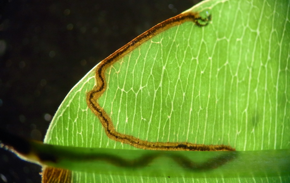
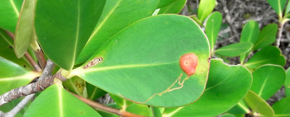
The idea that adaptation to different ecological environments can promote speciation dates back at least to Darwin (1859), and phytophagous insects have been at the forefront of a investigations of ‘ecological speciation’. It is clear that host shifts to different host plants can promote insect diversification and speciation. Host preference, performance on hosts, and host-specific mating played an important role in establishing the possibility of speciation in the face of gene flow. However, the order of evolution and relative importance of these key traits are poorly understood. I am studying the process and mechanism of host shifting and subsequent genetic differentiation using the leaf-mining moth Acrocercops transecta as a model system
The moth family Gracillariidae includes approximately 2000 described species. Larvae of the family mainly mine into a leaf and feed on inside tissues of the leaf, and surprisingly, they can mine into even epidermal cells! Mining strategies are highly varied; some species are flower miners, leaf droppers, stem miners, or fruits borers. I am studying systematics and phylogeny of Gracilalriidae with collaborators to reconstruct the evolution of these mining strategies and history of host shifting.